Wednesday, February 8, 2012

My Classic Frankenstein (Frankenstrat)


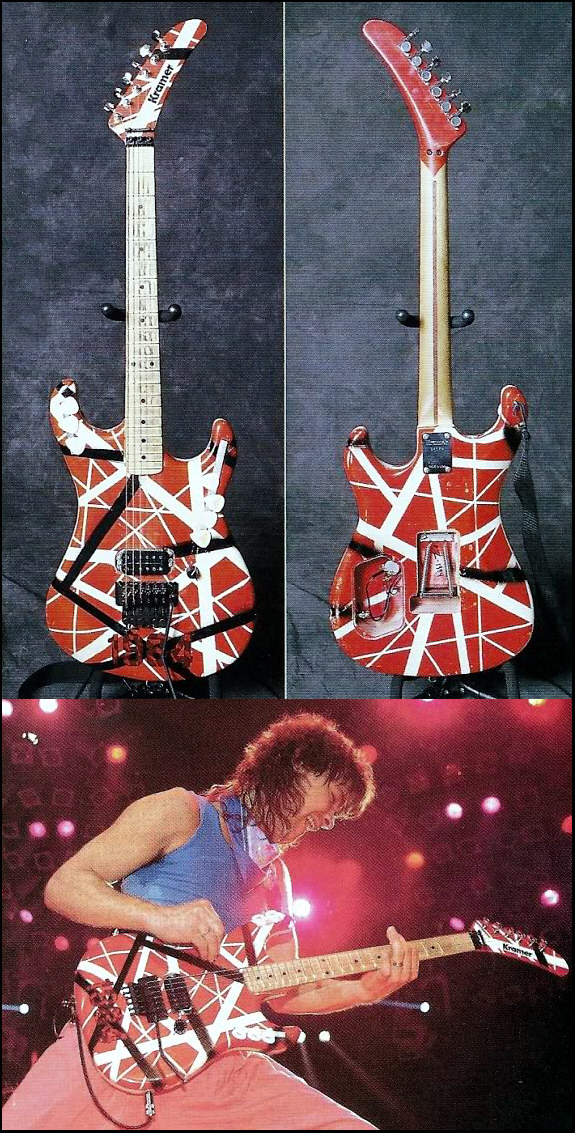
In 1984, Van Halen was the most popular rock band in the world. Not only had Eddie secured himself a legendary reputation as one of the most important guitarists of all time, but he had also secured a legendary design with his red, black & white striped Frankenstein of a guitar. In 1983, the legend of that stripe design was further cemented into pop culture by his endorsement relationship with Kramer guitars. It was during this time that Ed replaced the Fender Strat neck that he had previously used on the Frankenstein, with a Kramer Pacer neck. The official Frankenstein replica, built by Fender, contains a replica of the original Fender Strat neck, of course. I chose to make my replica with the Kramer Pacer neck, because I feel that it represents a more historic moment in the history of this legendary guitar.

I started with an ash body I found on Ebay that was routed to the exact routes of the original:

Sealed and primed with Black

Masking for the first set of stripes


(My son helping his obsessed father by spraying the coat of white)


First set of stripes after peeling the first mask

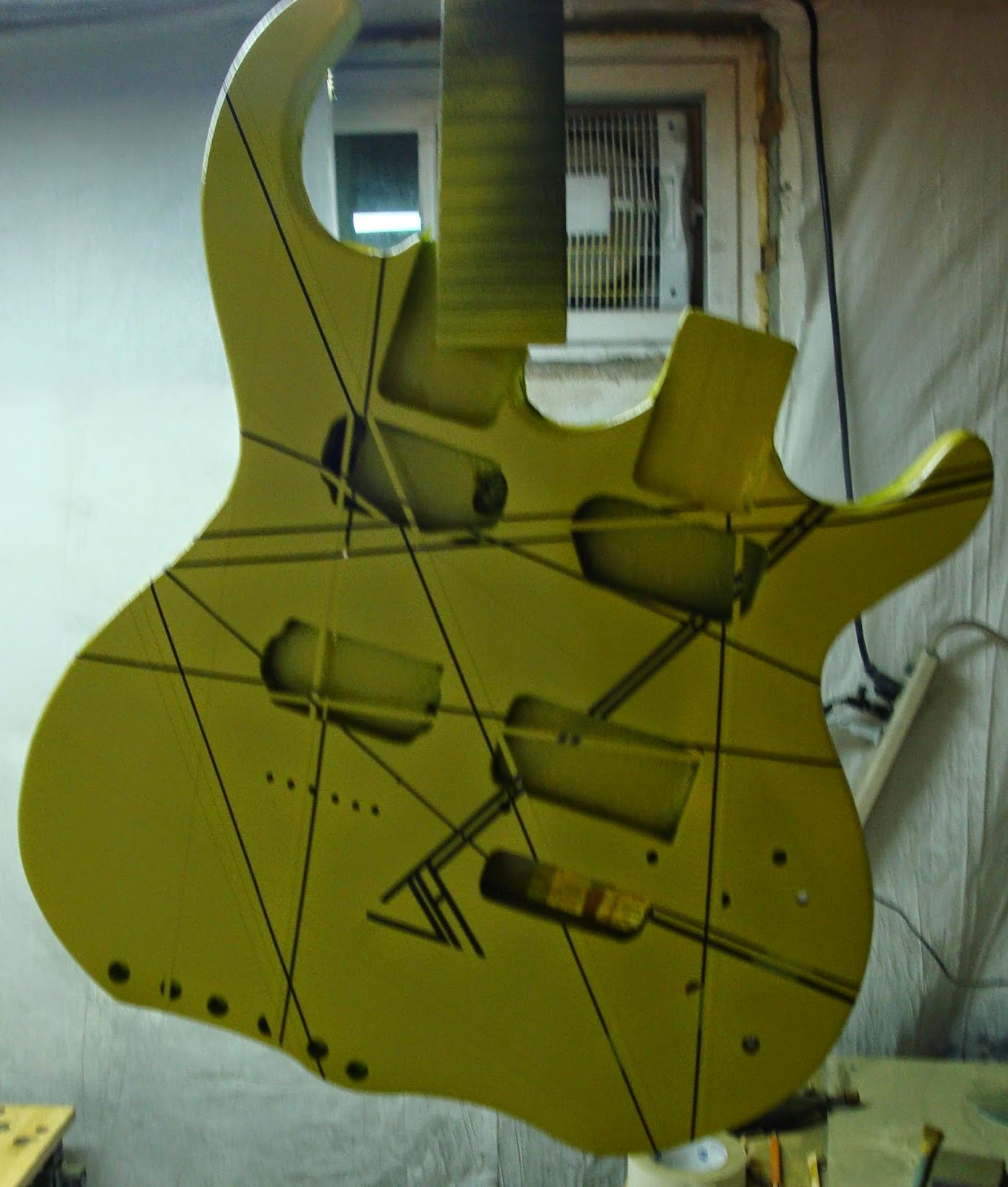
Second masking - FRONT

Second masking - BACK & SIDE

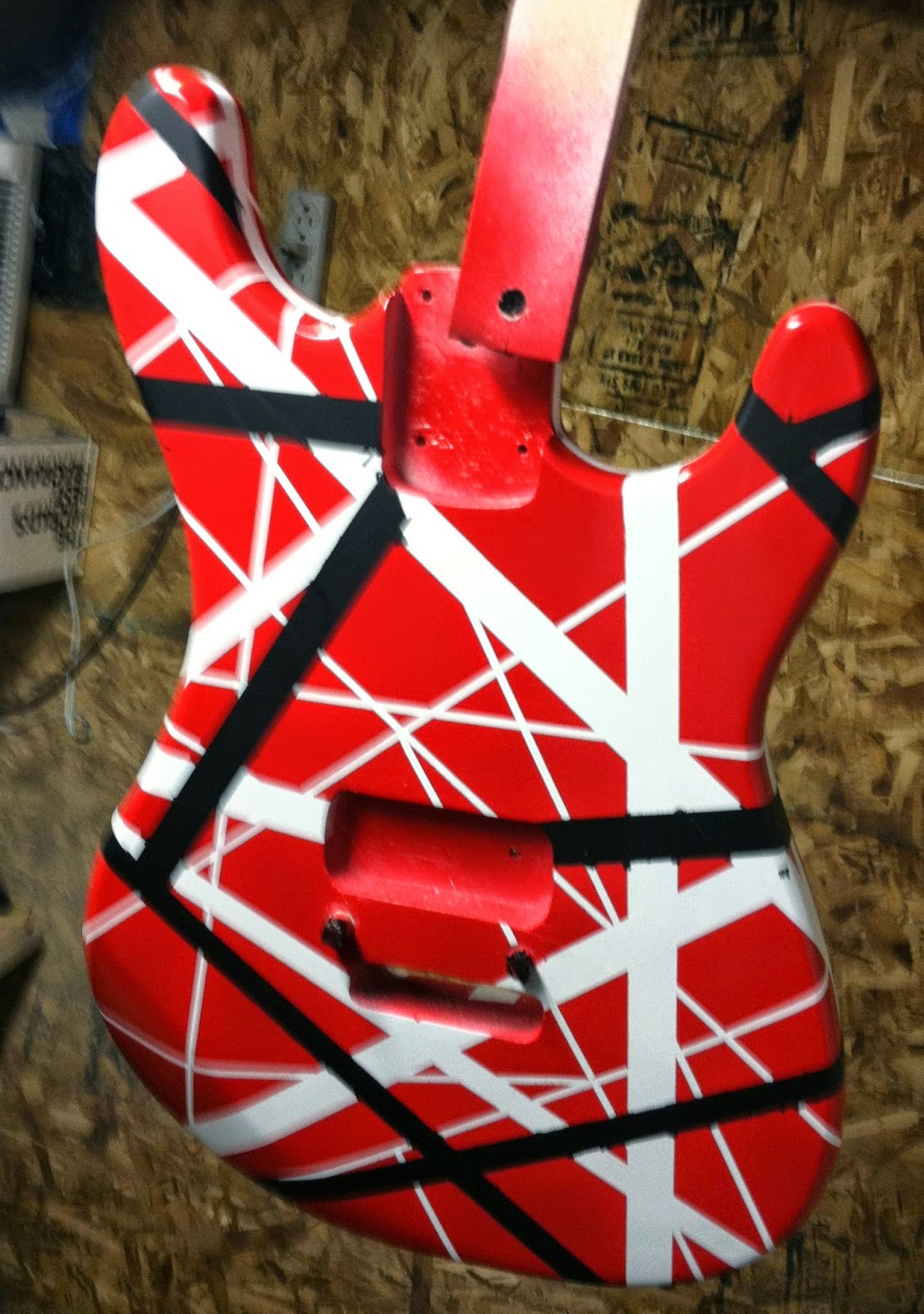
Red coat, after peeling mask - FRONT

Red coat, after peeling mask - BACK & SIDE
Reliced, BACK & SIDE
"Relicing", the act of making something look old and abused, was something new for me, and was a lot of fun! My relics aren't perfect, by any means, but they are close in location and shape!
Reliced, FRONT


Installed single coil pickup and 3-way switch in routes..

I bought this uncirculated 1971 quarter from the Littleton Coin Company

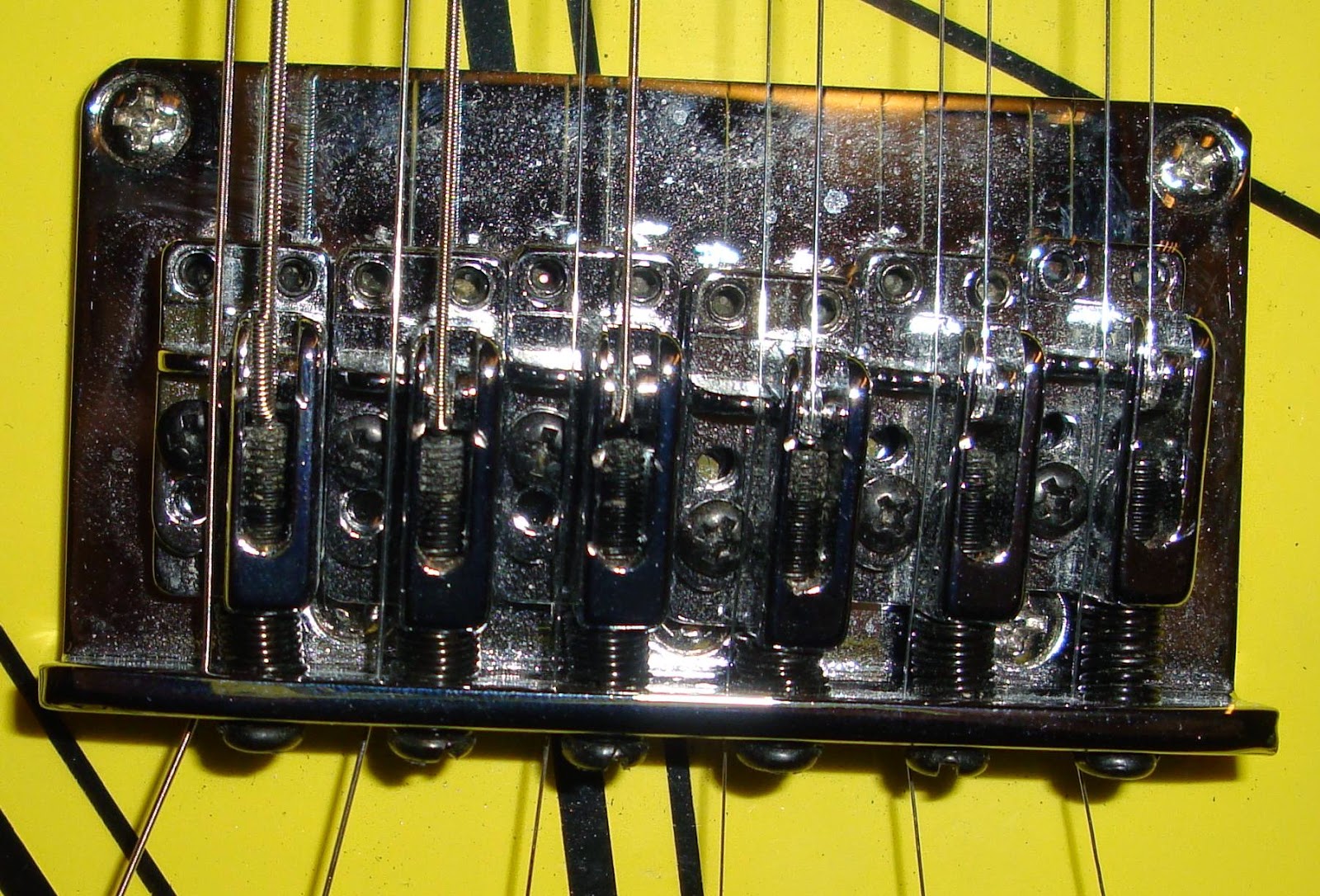
EVH Frankenstein Pickup, Floyd Rose from an 80's Kramer, and the '71 quarter mounted in trem-stopping position

Found these reflectors on Ebay. Broke one in half and left shaped residue
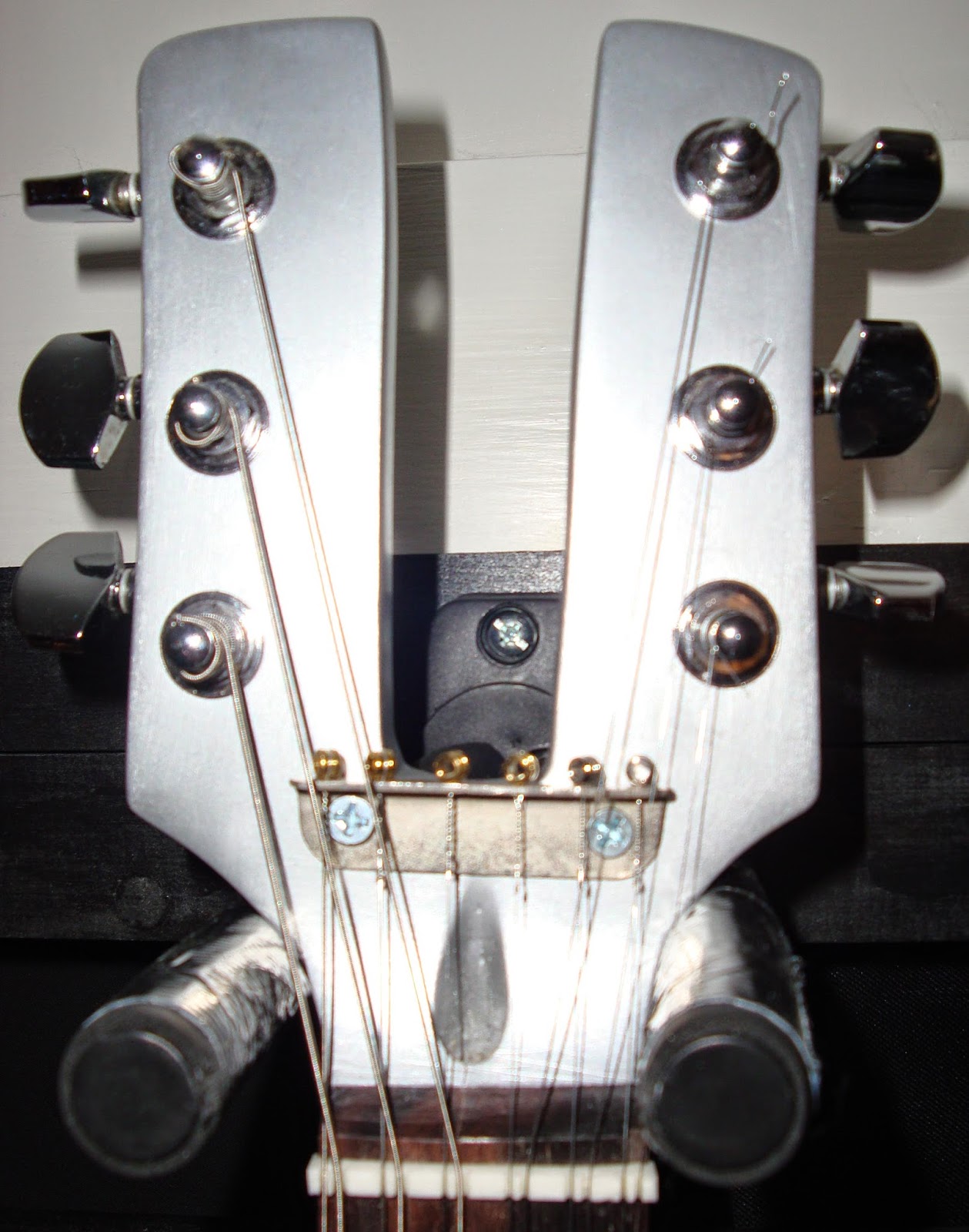
Kramer Pacer Neck with original 80's Floyd Rose locking nut
Original Schaller Tuners


Note the relicing on the headstock..
Added the correctly numbered neckplate, and spring formation, white duct tape under the springs


AND THE FINAL COMPARISON! LOOKS PRETTY GOOD TO ME!


Ed playing his Frankenstein...

Me playing my Frankenstein


After this project, I learned firsthand that the type of wood you use in an electric guitar really DOES make a difference in tone! The ash body makes this guitar sound like a Monster! For more history on this legendary guitar, click HERE

Next up, I'm going to try my hand at carving the Dragonsnake! (This one is going to be tough!)

Friday, July 15, 2011

My Little Les Paul

On April 14, 1982, Van Halen released their fifth album, Diver Down. Unlike the previous album which was all original music and very dark, this one was chock full of covers and much more upbeat. At this time, Ed's interest in bizarre guitars led him to pick up and customize some 1/4 scale Les Pauls, and made them famous via tracks 8 & 9 titled "Little Guitars".


To recreate this guitar, I purchased a 1/4 scale Les Paul style from a website called smallguitars.com for $170.00. These guitars are made for travel or children, but the quality of the workmanship is much better than any "First Act" toy you could find at Walmart. This is what the guitar looked like before the modifications:


It was already pretty close to the original, so I only had to make a few modifications:


1) Change the paint job
2) Change the pickups
3) Reduce the tone/volume controls from 4 to 2
4) Change the fret markers from dots to standard LP trapezoids
5) Change the nut and pickup rings from black to ivory
6) Add the VH logo decal to the headstock
7) Add the 1/4 scale pickguard


I sanded down the original paint job enough to cover it with a good sealer/primer job. I protected the pickup routes with tape, and filled in the two control knob holes with wood filler, sanded flush with the surface.


After masking off the one corner stripe, the red coat went on followed by 2 cans of gloss, wet sanding down flush, and another 2 cans of gloss lightly wet sanded between coats to give a semi-mirror finish.


Meanwhile, I scaled and drew 8 trapezoids and a VH logo to be scanned for "reflective white" decals. The decals were made by D & J Graphics. You may or may not notice that the VH logo decal is larger than the original. I got lazy & didn't want to sand down and repaint a perfectly good black gloss finish on the headstock so I made the decal large enough to cover the original brand name.


I replaced the nut and black pickup rings with ivory ones and replaced the pickups with real Gibson Les Paul chrome humbuckers, 490R (neck) and 490T (bridge). All of these items were purchased on Ebay. Tone and volume for each pickup were wired into one control knob each & patched through the Rhythm/Treble switch. I also purchased a white LP pickguard and gold LP pickguard bracket from Ebay. I cut the pickguard down to scale, and had to trim the long end of the bracket to get the pickguard in the proper position.


{click on image to enlarge}


Because of the smaller scale, thicker strings are needed to help stabilize the sensitive tuning. Ed also tuned his up a step and a half, so it's like a capo on the 3rd fret. With those Gibson pickups, this guitar really rocks, and it's amazing to hear such rage coming out of such a small package!


Friday, March 11, 2011

My Unchained "See Ya" Guitar


In 1981, Van Halen's "Fair Warning" was released. This fourth album was much darker, and contained more complex guitar arrangements than previous albums. Many of the songs on this album, including the Van Halen Anthem song "Unchained", were recorded in "Drop D" tuning, in which the low E string on the guitar was tuned a step down to D. To play these songs on tour, Ed needed to keep a guitar tuned to "Drop D". That was this guitar...

I bought this kit guitar, unfinished, on Ebay for $170. BUYER BEWARE: The hardware on these kit guitars is garbage, and the fret edges need to be filed down because they press them in the neck before the wood is dry. The body is decent, however, and you can't beat the price for a Floyd Rose Body & Neck. The first thing I did was cut a hole for the face jack, and fill the hole for the side jack.

This guitar came with a light coat of clear sealer on it, so I went straight to the white paint; about 6 light coats, and then onto the taping. I used a cutting compass for the circles. Note: cut the circles on wax paper or something, not on the guitar itself. The "lady shape" and the "yin-yang" was cut directly on the guitar with an exacto.


After the tape, about 4 light coats of black.

I waited about 5 minutes after the last coat before I started peeling the tape, and I got little to zero bleed.


I built up to 20 or 30 coats of clear gloss, lightly wet sanding between coats, and then I did a deep wet sand to bring all the surfaces level. Then I clear glossed another dozen coats or so, lightly wet sanding in between again. I cut & pasted the "Bye See Ya Later" from the original image and had decals made (special thanks to D.S. for making the decals)

I discarded the garbage hardware that came with the kit guitar, and loaded it up with real hardware, including an original Floyd Rose with fine tuners, and a white Seymour Duncan '78 without the SD logo, that I purchased from "Busy Pete's Music" on Ebay. I actually already owned a strap that matched (or is at least very similar to) the one Ed used for this guitar.

(click on any picture to enlarge)

Lesson Learned: Don't buy kit guitars! In the end, this guitar came out very nice & plays very well, but only after a lot of fighting with it! I could have saved a lot of headaches if I bought the body & neck separate, and it would have only cost me another $50 or so.